Are Stainless Steel Cutting Boards Bad for Knives? The Honest Answer
This is the number one objection to steel boards, and it deserves a straight answer instead of a sales pitch. So here it is: yes, a stainless steel cutting board dulls your knives faster than wood or plastic. Anyone who tells you otherwise is selling something. The useful question isn't whether steel is harder on an edge. It's how much harder, whether that matters for how you actually cook, and what you can do about it. The evidence has clear answers to all three.
The Part Everyone Gets Backwards
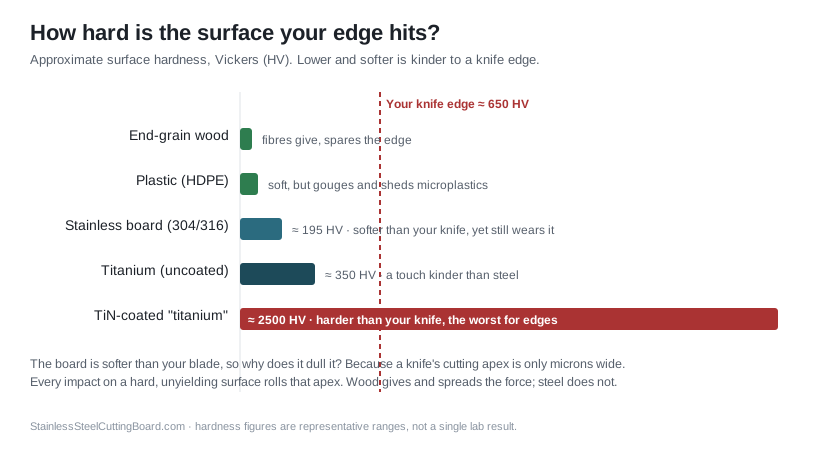
Here's the counterintuitive bit that trips people up. A stainless cutting board is actually softer than your knife. Kitchen knife steel runs roughly 54 to 58 HRC for German blades and 60 to 67 HRC for Japanese ones, which lands somewhere around 550 to 700 on the Vickers hardness scale. A 304 or 316 stainless board sits far lower, near HRB 80 to 95, or roughly 170 to 220 Vickers. Your knife is harder than the board.
So why does the softer board still dull the harder knife? Because the cutting edge of a knife is not the knife. The apex is only microns wide, thinner than a human hair, and it's fragile out of all proportion to the blade behind it. Every time that microscopic apex slams into a hard, unyielding surface, it rolls, deforms, and abrades a little. Wood fibers give and let the edge sink in, spreading the force. Steel gives almost nothing. The board doesn't have to be harder than the knife to wear the edge. It just has to refuse to move.
How Much Faster, in Numbers
Bench testing that chops a fixed number of times and measures edge retention gives a feel for the scale. In those comparisons, a knife loses roughly 20 to 30 percent of its sharpness after around 500 chops on stainless steel. On a gentler surface the same knife loses a good deal less over the same run. That's a real, measurable difference, and we're not going to wave it away.
But translate it into your kitchen. Five hundred chops is a lot of dinners. What the number really means is that if you move your heavy prep onto steel, you'll feel your knife wanting a touch-up sooner than you're used to, weeks sooner, not days. For most home cooks that's the difference between honing before every few sessions instead of once in a while. It is a tax, but it's a small and predictable one.
Does It Actually Matter for You? Three Honest Cases
If you already sharpen your knives: this barely registers. You own a honing steel, you use it, and going to a metal board just nudges your schedule up a notch. You are the person who loses the least here.
If you never sharpen your knives: the board is not your problem. Your knives are already dull from a year of no maintenance. A steel board will get blamed for a condition it didn't cause. The fix is a $20 sharpener and five minutes a month, not avoiding metal.
If you own expensive, hard Japanese knives: here the concern is real and different. Very hard steel above 62 HRC is not just harder, it's more brittle, and a hard, thin edge can chip rather than roll on a hard board. Keep those blades off steel entirely. Use them on a wood board and put a mid-range knife on the metal.
The Fixes, From Free to Cheap
- Match the knife to the board. Use a German-style or dedicated prep knife on steel. Save your hardest, thinnest blades for wood. This one habit removes most of the risk.
- Move food with the spine, never the edge. A lot of edge wear comes from scraping the blade sideways across metal to sweep food into a bowl. Turn the knife over and use the spine, or grab a bench scraper.
- Let the knife do the work. A death grip and heavy downward force roll an edge faster on a hard board. A sharp knife and a normal stroke beat brute force.
- Hone before you cook. A few passes on a honing rod realigns the edge and stretches the time between real sharpenings. On a metal board this is the single highest-value habit.
- Use the softer side when there is one. Several picks in our roundup have a wheat-straw flip side. Steel for meat, soft side for the knife-heavy vegetable work.
- Or buy the safety net. The MUGAA board builds a pull-through sharpener right into the frame, so a touch-up is always within reach. Fine for a working knife, not for your best Japanese blade.
Why People Still Choose Steel Anyway
Because the trade runs the other way once you weigh both sides. A steel board asks one thing: sharpen a little more often. In exchange it removes almost everything else. No oiling, no warping, no cracking, no stains, no onion smell that won't leave, and no deep knife gouges harboring bacteria or shedding plastic into your food. For raw meat and wet, smelly prep, the hygiene win is exactly what people came for, and the edge tax is a fair price. The standard honest setup is a steel board for those jobs and a wood board kept for fine knife work. That pair beats trying to make one board do everything.
Bottom line: Are stainless steel cutting boards bad for knives? They're harder on an edge than wood or plastic, measurably so, and pretending otherwise would be dishonest. But "harder on your edge" is not "ruins your knives." For anyone who sharpens, or is willing to start, the fix is free and the hygiene payoff is large. Keep your best blades on wood, put a working knife on steel, hone before you cook, and the objection quietly disappears.