Care and Knife Dulling: The Real Trade-Off of a Steel Board
Every honest conversation about stainless steel cutting boards runs into the same objection: won't it wreck my knives? The answer is that yes, steel dulls a blade faster than wood or plastic, and no, that's not the disaster people fear. Here's exactly what happens to your edge, how much it matters, and how to keep both the board and your knives in good shape. For the numbers behind the objection, the hardness data and edge-wear evidence, see are steel boards bad for knives. For cleaning, water spots, and dishwasher questions, see care and maintenance.
Yes, Steel Dulls Knives Faster. Here's How Much.
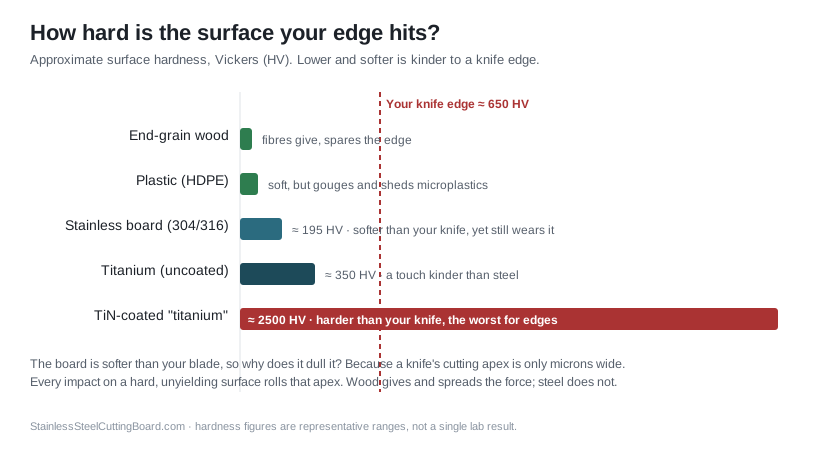
When your knife edge hits a hard surface, the edge takes the abuse instead of sinking in. Wood gives a little, so it's gentle. Plastic gives some. Steel gives almost nothing, so the microscopic edge rolls and wears faster. Practically, cooks who switch heavy prep to a metal board tend to sharpen noticeably more often than they did on wood.
What that means depends entirely on you. If you already hone your knife before use and sharpen every month or two, going to steel just nudges that schedule up a bit. You'll barely notice. If your knives are already dull because you've never sharpened them, the board isn't the villain in that story. And if you own genuinely expensive Japanese knives with hard, thin, brittle edges, keep those off steel entirely: hard edges can chip on a hard board. Use a beater knife on steel and save the good blade for wood.
How to Minimize the Dulling
- Match the knife to the board. Use a mid-range German-style knife or a dedicated prep knife on steel. Save your hardest, thinnest Japanese blades for a wood board.
- Cut, don't scrape. The edge wear comes as much from dragging the blade sideways across the metal to sweep food as it does from chopping. Use the spine of the knife or a bench scraper to move food, never the edge.
- Let the knife do the work. Heavy downward force on a hard board rolls the edge faster. A sharp knife and a normal stroke beat a death grip.
- Hone regularly. A few passes on a honing steel before you cook realigns the edge and stretches the time between real sharpenings. This is the single highest-value habit for anyone using a metal board.
- Use the softer side when there is one. Several picks in our roundup have a wheat-straw flip side. Use the steel for meat and the soft side for the knife-intensive vegetable work.
Caring for the Board Itself
This is where steel pays you back for the knife tax. There's almost nothing to do.
- Cleaning: Most 304 and 316 boards are dishwasher safe. Hand washing takes ten seconds anyway since nothing sticks or stains. If a board has a wheat-straw or PP side, check the label, those sides are often hand-wash only.
- Drying: Wipe or air dry. Quality 304 and 316 steel resists rust, but drying prevents water spots on the surface.
- Scratches: Your steel board will develop a haze of fine scratches. This is purely cosmetic. Unlike the deep knife gouges in a plastic board, which trap bacteria and shed plastic, scratches in non-porous steel hold nothing. A scratched steel board is just as sanitary as a new one.
- No oiling, ever. Wood needs regular oiling. Steel needs none. This is a real quality-of-life difference if you've ever forgotten to oil a wood board and watched it crack.
Solving the Two Annoyances: Noise and Slipping
Two complaints come up constantly with steel boards, and both are fixable.
Noise. Metal-on-metal chopping is louder than wood. A thicker board (look for 1mm or more) rings less than a thin one. Setting the board on a damp towel or a silicone mat kills most of the sound and does double duty on the next problem.
Slipping. A bare steel board can slide on a hard counter, which is genuinely unsafe with a knife in your hand. Buy a board with an anti-slip mat or folded grip edge included, or just put a damp dish towel underneath. Never chop on a board that moves.
Bottom line: A steel board asks one thing of you, that you sharpen your knives a little more often, and in exchange it removes basically all the other maintenance: no oiling, no staining, no odor, no bacteria-harboring gouges, no microplastics. Keep a wood board for your best knives and delicate work, run a damp towel under the steel for noise and grip, and the trade comes out strongly in steel's favor for the jobs it's meant for.